Happy May 1st everyone! Today, we’re going to celebrate the iconic civil rights group
The Lavender Menace and how they fought back against homophobia in the Women’s
Rights Movement by protesting the Second Congress to Unite Women on this day in
1970.
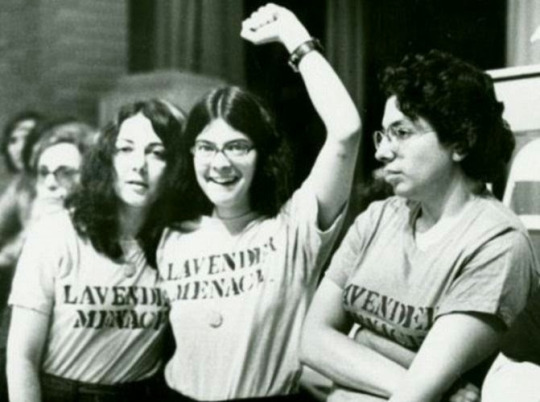
Three members of The Lavender Menace celebrate after having successfully completed a Zap during the Second Congress to Unite Women. A Zap is a form of political protest pioneered by LGBT Rights activists which involved the public embarrassment of a celebrity or public figure (x).
In high school, you may have read about Betty Friedan as the
brave author of The Feminine Mystique
and as one of the women who launched the second wave feminist movement.
Although to some, Betty Friedan is a feminist hero, if you ask most lesbians
what they think about Betty Friedan you’ll probably get a completely different
reaction. In 1969, as the president of the National Organization for Women
(NOW), Betty gave a speech in which she identified lesbians in the Women’s
Rights Movement as the “lavender menace,” a villainous group that was holding back
the movement from being accepted by mainstream society. What followed was a
careful plan for NOW to distance itself from lesbians and lesbian issues by
blacklisting the Daughters of Bilitis.
Rita Mae Brown stands defiant in her Lavender Menace shirt amongst a group of NOW members (x).
This clear act of homophobia enraged one lesbian activist by
the name of Rita Mae Brown. Scorned and impassioned, Rita and other lesbian
activists left NOW and formed their own group that would welcome lesbians in
and focus specifically on lesbian civil rights issues. The name they chose for
themselves? The Lavender Menace. For the groups’ coming out party (no pun
intended), the organizers of The Lavender Menace chose the Second Congress to
Unite Women, which was being held in New York City on May 1, 1970. Decked out
in lavender colored shirts and holding protest signs, the women of The Lavender
Menace infiltrated the auditorium where the Congress’s opening remarks were
being made, cut the lights and the microphone, and hijacked the stage. Although
there were members of the crowd who booed, many of the women at the Congress
listened to what the Menaces had to say and allowed their protest to continue. Karla
Jay, one of the women who was a part of the protest recalls that “the audience
was on our side.”


 Lady Jace Of The Fae